Unified Memory
Unified memory simplifies the explicit data movement from the host to the device for programmers. The OpenACC API automatically manages data transfer between the CPU and the GPU. In this example, we will explore vector addition on the GPU utilizing the unified memory concept.
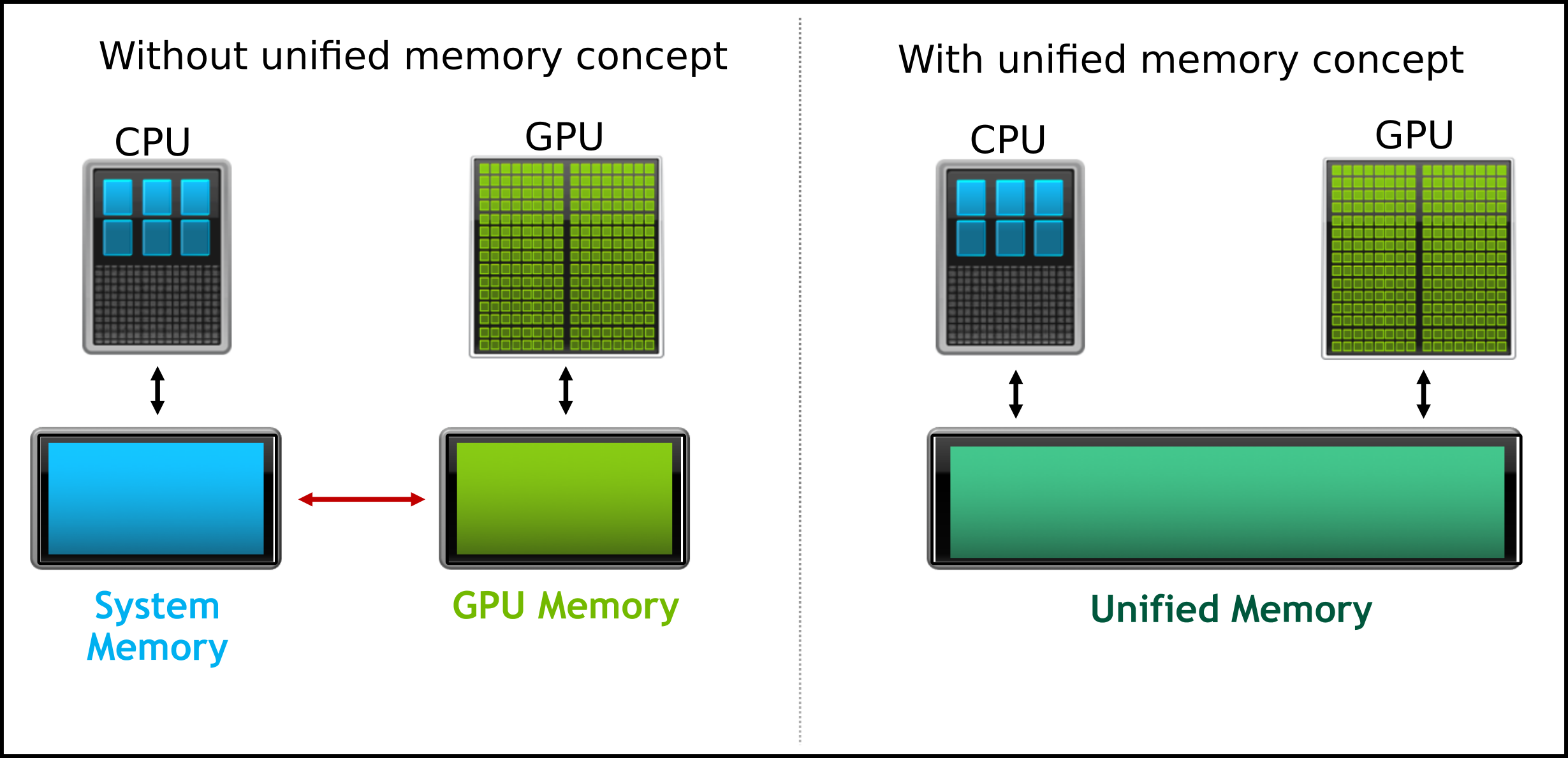
Illustration of Unified Memory Concept
To enable unified memory in OpenACC, it is sufficient to use the compiler flag -gpu=managed.
The following table summarizes the required steps for implementing the unified memory concept:
Unified Memory
nvc -fast -acc=gpu -gpu=cc80 -gpu=managed -Minfo=accel test.c
nvfortran -fast -acc=gpu -gpu=cc80 -gpu=managed -Minfo=accel test.f90
Without unified memory |
With unified memory |
|---|---|
Allocate the host memory |
Allocate the host memory |
Initialize the host value |
Initialize the host value |
Use data clauses, e.g., copy, copyin |
~~Use data clauses, e.g., copy, copyin~~ |
Do the computation using the GPU kernel |
Do the computation using the GPU kernel |
Free host memory |
Free host memory |
Questions and Solutions
Examples: Vector Addition
// Vector-addition-template.c

#include <stdio.h>
#include <stdlib.h>
#include <math.h>
#include <assert.h>
#include <time.h>
#include <openacc.h>

#define N 5120
#define MAX_ERR 1e-6

// GPU function that adds two vectors
void Vector_Addition(float *restrict a, float *restrict b, float *restrict c, int n)
{
// add here either parallel or kernel and do not need to add data map clauses
#pragma acc
for(int i = 0; i < n; i ++)
   {
     c[i] = a[i] + b[i];
   }
}

int main()
{
  float *restrict a, *restrict b, *restrict c;

  a = (float*)malloc(sizeof(float) * N);
  b = (float*)malloc(sizeof(float) * N);
  c = (float*)malloc(sizeof(float) * N);

  for(int i = 0; i < N; i++)
    { a[i] = 1.0f; b[i] = 2.0f; }

  clock_t start = clock();
  Vector_Addition(a, b, c, N);
  clock_t end = clock();
  double elapsed = (double)(end - start)/CLOCKS_PER_SEC;

  printf("Time measured: %.3f seconds.\n", elapsed);

  for(int i = 0; i < N; i++)
    { assert(fabs(c[i] - a[i] - b[i]) < MAX_ERR); }

  printf("PASSED\n");
  free(a); free(b); free(c);
  return 0;
}
// Vector-addition-openacc.c

#include <stdio.h>
#include <stdlib.h>
#include <math.h>
#include <assert.h>
#include <time.h>
#include <openacc.h>

#define N 5120
#define MAX_ERR 1e-6

void Vector_Addition(float *restrict a, float *restrict b, float *restrict c, int n)
{
#pragma acc kernels loop
for(int i = 0; i < n; i ++)
   { c[i] = a[i] + b[i]; }
}

int main()
{
  float *restrict a, *restrict b, *restrict c;

  a = (float*)malloc(sizeof(float) * N);
  b = (float*)malloc(sizeof(float) * N);
  c = (float*)malloc(sizeof(float) * N);

  for(int i = 0; i < N; i++)
    { a[i] = 1.0f; b[i] = 2.0f; }

  clock_t start = clock();
  Vector_Addition(a, b, c, N);
  clock_t end = clock();
  double elapsed = (double)(end - start)/CLOCKS_PER_SEC;

  printf("Time measured: %.3f seconds.\n", elapsed);

  for(int i = 0; i < N; i++)
    { assert(fabs(c[i] - a[i] - b[i]) < MAX_ERR); }

  printf("PASSED\n");
  free(a); free(b); free(c);
  return 0;
}
!! Vector-addition-template.f90

module Vector_Addition_Mod
  implicit none
contains
 subroutine Vector_Addition(a, b, c, n)
    real(8), intent(in), dimension(:) :: a
    real(8), intent(in), dimension(:) :: b
    real(8), intent(out), dimension(:) :: c
    integer :: i, n
    ! add here your acc directive
    do i = 1, n
       c(i) = a(i) + b(i)
    end do
  end subroutine Vector_Addition
end module Vector_Addition_Mod

program main
  use openacc
  use Vector_Addition_Mod
  implicit none
  real(8), dimension(:), allocatable :: a, b, c
  integer :: n, i

  print *, "This program does the addition of two vectors "
  print *, "Please specify the vector size = "
  read *, n

  allocate(a(n)); allocate(b(n)); allocate(c(n))

  do i = 1, n
     a(i) = sin(i*1D0) * sin(i*1D0)
     b(i) = cos(i*1D0) * cos(i*1D0)
  enddo

  call Vector_Addition(a, b, c, n)

  do i = 1, n
     if (abs(c(i)-(a(i)+b(i)))==0.00000) then
     else
        print *, "FAIL"
     endif
  enddo
  print *, "PASS"

  deallocate(a); deallocate(b); deallocate(c)
end program main
!! Vector-addition-openacc.f90

module Vector_Addition_Mod
  implicit none
contains
 subroutine Vector_Addition(a, b, c, n)
    real(8), intent(in), dimension(:) :: a
    real(8), intent(in), dimension(:) :: b
    real(8), intent(out), dimension(:) :: c
    integer :: i, n
    !$acc parallel loop
    do i = 1, n
       c(i) = a(i) + b(i)
    end do
    !$acc end parallel
  end subroutine Vector_Addition
end module Vector_Addition_Mod

program main
  use openacc
  use Vector_Addition_Mod
  implicit none
  real(8), dimension(:), allocatable :: a, b, c
  integer :: n, i

  print *, "This program does the addition of two vectors "
  print *, "Please specify the vector size = "
  read *, n

  allocate(a(n)); allocate(b(n)); allocate(c(n))

  do i = 1, n
     a(i) = sin(i*1D0) * sin(i*1D0)
     b(i) = cos(i*1D0) * cos(i*1D0)
  enddo

  call Vector_Addition(a, b, c, n)

  do i = 1, n
     if (abs(c(i)-(a(i)+b(i)))==0.00000) then
     else
        print *, "FAIL"
     endif
  enddo
  print *, "PASS"

  deallocate(a); deallocate(b); deallocate(c)
end program main
Compilation and Output
// compilation
$ nvc -fast -acc=gpu -gpu=cc80 -Minfo=accel -gpu=managed Vector-addition-openacc.c -o Vector-Addition-GPU
Vector_Addition:
12, Generating copyin(a[:n]) [if not already present]
    Generating copyout(c[:n]) [if not already present]
    Generating copyin(b[:n]) [if not already present]
14, Loop is parallelizable
    Generating NVIDIA GPU code
    14, #pragma acc loop gang, vector(128) /* blockIdx.x threadIdx.x */

// execution
$ ./Vector-Addition-GPU

// output
PASSED
// compilation
$ nvfortran -fast -acc=gpu -gpu=cc80 -gpu=managed -Minfo=accel Vector-addition-openacc.f90 -o Vector-Addition-GPU
vector_addition:
     12, Generating NVIDIA GPU code
         13, !$acc loop gang, vector(128) ! blockidx%x threadidx%x
     12, Generating implicit copyin(a(:n)) [if not already present]
         Generating implicit copyout(c(:n)) [if not already present]
         Generating implicit copyin(b(:n)) [if not already present]

// execution
$ ./Vector-Addition-GPU

// output
This program does the addition of two vectors
Please specify the vector size =
1000000
PASS
Questions
Have you noticed any performance improvements when using unified memory?